Thursday, March 21, 2019

Between the Lines

Ruchi Singh interned with us at Karadi Tales for four months between December 2018 and March 2019 as a part of her Bachelor’s in Design from the Faculty of Fine Arts, M. S. University, Vadodara. During her design internship with us, she was given the project of illustrating a board book, Something’s Falling. The book was on falling objects such as fruits, leaves, and so on, and Ruchi had the challenge of not only illustrating this book, but coming up with an innovative way in which to make the objects seem as though they were quite literally falling off the pages! She brought her own unique style inspired by Indian folk art to her illustrations. This is her blog on her experience working with us and illustrating her own book.

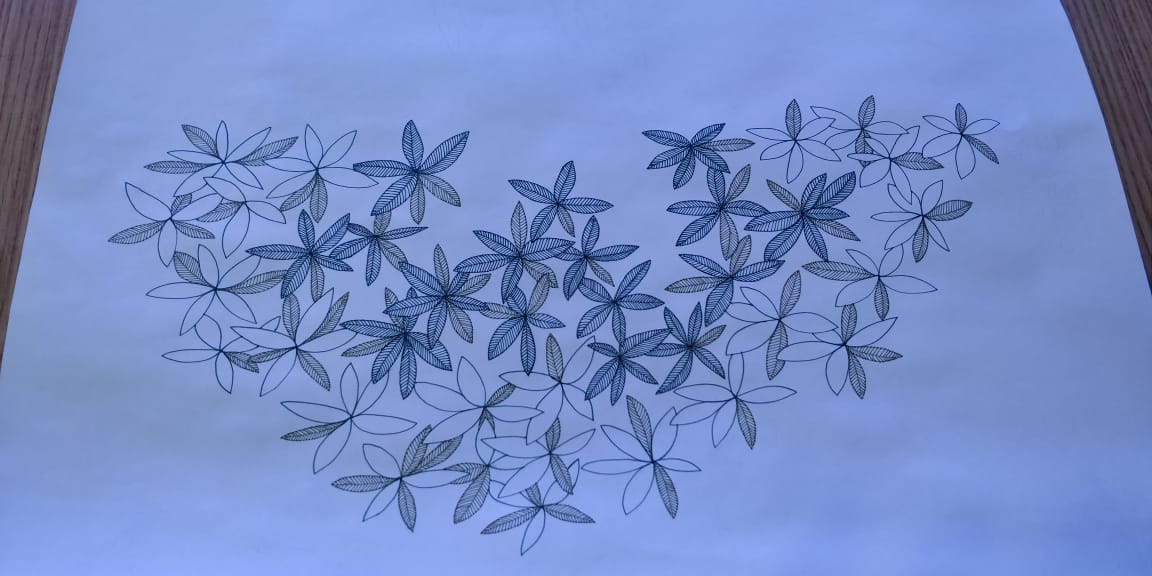
Doing an internship and consequently illustrating ‘Something’s Falling’ was a part of my degree project. I like to play with lines and patterns made of lines. As children’s books are usually coloured, my initial experiments for the illustrations made me question whether we could colour with lines. “Why not?” I asked myself. This led me to a very different technique of illustrating with coloured lines. The patterns formed by lines inside a shape, in this case, would need to be very close so that the shape seems filled with colour. This technique seeks to capture the ‘feeling’ of colour rather than its traditional depiction. The child reading the book would learn that imitation isn’t always important, and catching the ‘essence’ of something and representing it in one’s own style can do wonders.

Drawing the illustrations was a fun experience, for which I used coloured ink pens. As the book has flaps that fold out to tell the story, figuring out how to fit the art into the print format was a bit puzzling. But when I looked at the finished sample of the book, I was surprised and delighted. The flaps really added to the feeling that the story was ‘falling’ out of the book.
Karadi Tales has a very open mind for styles of illustration. They are open to experimenting with techniques, media, and ways of telling a story. At the beginning of the internship, I wasn’t very sure if they would agree with my style and experiments, but their positive response encouraged me to challenge myself. During my time here, I learned many things from the KT team. They are a helpful and broad-minded group of people. Along with my widened perspective of children’s books, my decision-making skills and presentation skills also improved. Interning here has been a great, fulfilling experience.


Friday, February 22, 2019

Of Joyrides and Mayhem


Krishna Bala Shenoi, illustrator of Get Off That Camel spends his days making things. His artwork, spanning a variety of styles, has accompanied children’s literature in books produced by esteemed publishing houses. He lives in Bangalore with his family of humans and cats, where he plans to continue contributing to children’s storytelling, imbuing his work with gentleness and a sense of wonder.


What did you like about the story Get Off That Camel that made you want to illustrate it?

More than anything, it was the opportunity to bring a kind of unbridled wackiness to my illustrations. Most of my books so far have been quiet and sober and gentle, so it was nice to be able to draw a delirious girl riding a giant camel through a crowd of panicked people. And I liked that there was an opportunity to draw a world around our central characters, reacting to them with a variety of emotions. The book demanded a level of detail and richness of me that I haven't really given before.

Was there anything challenging about illustrating this particular story?


Quite a bit, actually. First of all, I didn't know how to draw a camel at all. Besides the usual practice of studying images and sketching from them repeatedly, I bought a little model of a camel that I used for reference. It helped a lot with some of the more unique angles in the book (like the top angle used in the supermarket, for example).

Another challenge was managing the wild scales of the book - the camel and the girl are wildly different in stature, and yet both of their emotions had to be readable throughout the images. Beyond that, I had to find interesting ways to fit the camel into spaces and places she wouldn't fit without it feeling repetitive. Each spread had to feel like a fresh version of, essentially, the same joke.

It was also tricky to load my illustrations with detail and yet not lose Meena and the camel in the chaos. Often, I had to peel back some details elsewhere to bring the image back on track.

I think the most challenging thing about the book, though, was keeping the whole thing a lot of fun while also accounting for the impending separation between Meena and her camel - the doctor
discovers that the camel has been tired for a while. I needed the Meena's realization in that moment to ring true without contradicting the happy shenanigans in the previous pages.


Could you give us an example of a time where you built on the story and added your own elements that aren’t mentioned in text?

 
A. H. Benjamin's text was very sparse in terms of details and tone, and though that demands a lot more thought from an illustrator, it's ultimately a gift for an illustrator--you can bring that much more to the book yourself. Every illustration is full of little details and reactions and flourishes that had no source in the text, simply because the text was so beautifully taut.


As for a specific example of an element I added... there were little things, like the idea that Meena is an artist. I've hidden her drawings of camels here and there in the book, and eagle eyed readers might notice that she actually gets better at drawing as she ages, as one does.

Another element I was particular about adding was some company for the camel at the shelter, at the end. I didn't want her to go off to a shelter while Meena went back to her family - I needed young readers to know that the camel too had people of her own to be with.

I believe you could give this particular text to five different illustrators and come out with five very unique books. I decided to go with something absurd and over the top, because my first reading of the text made me laugh out loud several times.

Do you have a favourite picture book (or artist) whose illustrations you admire?

I love the stillness Chris Van Allsburg brings to his art. His work is so noiseless and moody and evocative. And more recently, I discovered Oliver Jeffers and his ability to tell such compelling, tender, complicated stories with deceptively simple images. "The Heart and the Bottle" distils the complexity of great loss into something anyone could understand and feel. This isn't a picture book per se, but Patrick Benson's illustrations for Roald Dahl's "The Minpins" create such an enormous, lush, inviting, detailed world. I remember opening that book as a child and just staring at it. James Gurney is one of the artists I admire most, for his ability to make the fantastic seem absolutely real.

Right now, I also get a lot of inspiration from several contemporary Indian illustrators (some also working in picture books). They're so excellent with their craft and constantly make me want to up my game. A few names, off the top of my head: Lavanya Naidu, Rajiv Eipe, Roopsha Mandal, Sandhya Prabhat, Sarthak Kath, Sayan Mukherjee, Upamanyu Bhattacharyya, Vibhav Singh.

I'm sure I'm going to read this later and slap myself for not recalling other significant influences and inspirations.

What medium do you prefer working with while illustrating?

I've done every single one of my nine books (so far) digitally. It allows me to work faster (not fast enough, though), make the numerous corrections publishers ask for more easily, and work and re-work my illustrations the way I like to do. Even so, I almost always try to emulate some of the qualities of classical media because I have a personal preference for them in my own art.

And finally, do you plan on illustrating any more books for Karadi Tales?

No question. I loved working with Karadi Tales. I was given such freedom to make this book my own while also being guided the whole time, and they were incredibly accommodating throughout the process. I'm immeasurably proud of the work we've done together and will be working with them on something as soon as I can and as soon as they will have me.

Saturday, February 16, 2019

Karadi Tales Shortlisted For London Book Fair International Excellence Award


Ahead of the 48th annual London Book Fair, the shortlist for the International Excellence Awards for publishers has been announced. Chennai-based children’s publishing house Karadi Tales has been shortlisted for the Audiobook Publisher of the Year Award on the basis of its high-quality content and its partnership with the Karadi Path Education Company.

Karadi Tales is an award-winning independent children’s book publishing house that was founded in 1996. Its picture books and audiobooks have been on prestigious lists such as The New York Public Library’s Best Children’s Books, White Ravens, IBBY, the Amelia Bloomer list and the Dolly Parton Imagination Library Program, and have sold translation rights around the world. Karadi Tales was a pioneer in the children’s audiobook industry in India, with stories narrated by acclaimed theatre and film personalities, and set to professionally performed music.

Karadi Path was founded in 2010 as Karadi Tales’ partner company with the aim of bridging the cavernous English literacy gap in India by using stories and immersive learning. The award-winning Karadi Path pedagogy saw exponential success and is now part of the curriculum in over 3000 schools, benefiting over half a million students, many of whom are at the bottom of the income pyramid, with limited access to English language learning tools. All Karadi Path programmes feature content from Karadi Tales.

Karadi Path has partnered with the Indian Government’s Sarva Shiksha Abhiyan, The State Council of Educational Research and Training, and schools for tribal children, girl children, and minorities, and has been recognized by USAID and the San Francisco-based Project Literacy Lab for its effectiveness in environments with limited infrastructure and for first-generation English learners.

The Karadi Tales-Karadi Path business model is a unique one that brings high-quality, low-cost products to those who need it most, and has been recognized for its innovativeness in this sector.

Every year, the London Book Fair sees participation of over 25,000 publishing professionals from around the world. The LBF International Excellence Awards ceremony will take place on Tuesday, 12 March, 2019 in The Conference Centre, Olympia, London.

Thursday, February 14, 2019

Interview with Chitra Soundar - Author of the Beloved Farmer Falgu Series


Chitra Soundar is the author of the much-loved Farmer Falgu series. She hails from India, resides in London, and lives in imaginary worlds woven out of stories. She has written over twenty books for children, ages 3 - 10. Here, she talks about what inspired the Farmer Falgu books, and the creative choices she made while writing the series.


How did you decide which festivals and events Farmer Falgu would attend from the many options available?

When the first two books of Farmer Falgu were published, I created many activities for Sankaranthi, the harvest festival. That’s when I discovered the kite festival that happens in Rajasthan during this time and hence I thought it would be fun for Farmer Falgu and his daughter to fly kites.

Farmer Falgu is ever the optimist, why do you think that’s important to have a character like that in children’s literature?

Farmer Falgu takes after my grandmother and her advice for me as a child – always see the positive side of things. As a child, I grew up thanking about my blessings than worrying about what I didn’t have. Children who learn resilience at a young age are able to cope with disappointments better and they will keep trying until they achieve their goal. Telling this in stories will help children understand through another character without preaching to them.

In Farmer Falgu Goes to the Kumbh Mela, was it a conscious decision to show him being kind even when it meant losing out on something he'd been looking forward to?

I think in today’s world we all need to think outside our own needs. Farmer Falgu cannot walk past someone who has fallen down or is lost, just to get to his destination. That’s not the kind of person he is. It actually has the underlying motto from Bhagavad Gita – Do your duty, do not expect results. And that’s what he does too. A hero is someone who is kind and courageous despite the outcome and not because of the outcome and hence for me Farmer Falgu is kind and considerate first and foremost.

And finally, did you always want Farmer Falgu to be a series or had you only planned for one book initially?

At first it was only one story I sent to Karadi Tales. And then the second one came to me and Karadi Tales agreed to publish it. The series idea was from Shobha, our publisher who loves Farmer Falgu as much as I do and wanted more stories for him.

Wednesday, January 30, 2019

Awards, Awards, and More Awards!


It’s been a great season for us at Karadi Tales when it comes to awards. Several of our titles were nominated, and quite a few were winners.

The Clever Tailor by Srividhya Venkat, illustrated by Nayantara Surendranath won the Peek-A-Book Children’s Choice Award in the 5 to 6 age category, while 8563 by Soumitra Ranade and Rudradutt Ranade illustrated by Ambika Sambasivan was nominated in the 11 to 12 years category!

Thukpa For All by Praba Ram and Sheela Preuitt, illustrated by Shilpa Ranade has been selected for the 2019 IBBY list of Outstanding Books for Young People with Disabilities. It is our second book to be featured on this list, the first being the audiobook version of Little Vinayak, which was featured on the 2013 list. The IBBY (International Board on Books for Young People) are a non-profit organization whose mission it is to promote international understanding through children's books, give children everywhere the opportunity to have access to books with high literary and artistic standards, and encourage the publication and distribution of quality children's books, especially in developing countries.

For the third year in a row, one of our books won the Jarul Book Award. Papa’s Marathon by Nalini Sorensen, illustrated by Prashant Soni was this year’s winner, and Sadiq Wants to Stitch by Mamta Nainy, illustrated by Niloufer Wadia was nominated. The Jarul book award is a children’s choice award which makes this even more special. Children from kindergarten to grade five are given a chance to read and vote for the best book. Previous titles of ours that have won this award are The Night Monster (2017), and Dada’s Useless Present (2018).

Farmer Falgu Goes to the Market has been featured in the 2019 USBBY Outstanding International Book List! It is our second book to make it to the list, the first being The Blue Jackal which made it to the 2017 Outstanding International Book List. Every year, USBBY’s Outstanding International Book committee sits down to select books that represent the best of children's literature from countries other than the US that exhibit a distinct cultural flavour, have artistic and literary merit, and qualities that engage and appeal to children. It is a huge honour for our book to be included on this prestigious list.

Monday, August 6, 2018

Behind the Scenes of "Something's Moving"

Have you ever wished you could swing like a monkey, glide like a swan, or bound like a deer? Author Daya Subramanian tells us what inspired her lovely poetry in our recently launched picture book "Something's Moving". Featuring stunning folk art by Anusha Sundar, the book features the various movements of animals, and has been praised by reviewers as having 'delightful verses' (Booked For Life) and being 'a beautiful book to read aloud' (Myth Aunty).


Read on to find out what talented author (and member of Karadi Tales' editorial team) has to say about her writing process!


Have you always been interested in poetry?

Yes, I have, but I had never tried writing poems or rhymes before Shobha (Viswanath, Publisher – Karadi Tales) asked me to give it a try.
My undergraduate degree was in English Literature and Poetry was my favourite subject. Deconstructing poems is so fascinating to me. I was a big fan of Robert Browning’s poems – I got hooked on to them after studying My Last Duchess when I was in 10th grade. I have a couple of other stories in mind and I can’t imagine writing them in anything other than verse now - I think anything sounds better in verse!

Why animals, why movements – how did this story come about?

Shobha showed me some completed illustrations of animals done beautifully in Indian folk-art style. Anusha Sundar, an intern at Karadi Tales at the time, had drawn them and put them together. Shobha asked me to try and think of some text to go along with it – it could be a story or just a child observing various animals. She gave me complete freedom to decide how I wanted to write it – the only thing was it had to be about animal movements and include a verb for each animal. For instance, ‘bound’ for deer, and ‘slither’ for snake. I decided to have a child fascinated by animals narrate how much she wished she could move like them. I for one am definitely reminded of our human limitations every time I think of how fast a cheetah can run or how high a bird can fly. So I guess that is reflected in the book.  

What are some other books that are cooking in your mind?

I want to write a book about a child who keeps getting lost in daydreams (because this is a problem I’ve had my entire life!) She daydreams about living underwater with whales during biology class and being able to make herself invisible and create mischief while she is at a boring party. I think her extremely wild imagination might make for some nice illustrations too.

Any advice for aspiring children’s book authors?

As this is my first book, I don’t know if I’m experienced enough to give advice! But going by my childhood experience of reading and loving books (and my limited experience working in a children’s publishing house) I’d say don’t dumb down the text for children. And if there are a couple of words they don’t understand, that’s alright, it can be used as an opportunity to learn the word. A three-year-old child might not know what ‘tranquil’ means but they might understand what it means based on the context.
Also, take constructive advice when it is given to you by someone with experience in children’s publishing and be willing to modify your story a bit!


The book "Something's Moving" can be purchased through this link:

https://www.karaditales.com/catalogue/picture-books/somethings-moving/

Tuesday, July 17, 2018

In a New Avatar


For the past 22 years, Karadi the bear has appeared in pages of numerous Karadi Tales books, on screen in animated TV shows, and as a mascot at our events. And for the first time, a couple of months ago, he took the shape of a three-dimensional sculpture who now sits in our office.  


Mahalakshmi Gurushankar brought the popular image of a dancing Karadi and his young monkey friend Meera to life with such incredible detail that one might actually think it is 3D printed rather than painstakingly hand-carved! Every little detail from Meera’s flying necklace to what looks like almost every single strand of Karadi’s fur is present in the sculpture. She took the time to add grass, real stones and even a little plastic butterfly to complete the image of the storytelling bear in his home, the forest. When asked how she was able to capture such intricate details in the sculpture, Mahalakshmi said, “I started by creating a wire frame. The sculpture is made of polymer clay but needs a foundation. Once that was ready I could move on to the smaller details like the fur. I have small hands so making small things is not a problem. I used dentist tools which I actually found are the best and cheapest for this sort of thing. The trick is to be extremely delicate. I didn’t have much difficulty getting as close as possible to the existing 2d character.”
Making the sculpture did not take Mahalakshmi very long. She worked on it for two hours a day and was done within a week. “The first time the facial proportions were off. So it took another week to redo that and this time it was perfect” she said.
Surprisingly, Mahalakshmi does not have a background in sculpting. “I had not learnt sculpting as part of a course before, but I did have a couple of classes in it during animation studies. The first time I ever tried my hand at it was during a competition at school. That was my first time trying it. I had no idea what I was doing but decided to have fun anyway. I did not win anything in that competition, but I clearly remember one of the participants making a dog cradling her puppies…it made me want to try harder. I learnt a lot from YouTube tutorials and by trial and error - I began by just playing around with different types of clay and soon made it a point every Ganesh Chathurti to make my own Ganeshas for Visarjan.”
Today, the painstakingly created sculpture from our beloved reader sits in our office alongside us every day. And sometimes, when the sun shines on Karadi’s face, we almost feel like the big, lovable bear is grinning at us meaningfully, as if to say – “Do you have any new stories for me to tell?”


Saturday, May 5, 2018

Discovering India Through Karadi Tales


(Noemie Bellanger interned with us during the month of April 2018. She writes about her experience working with Karadi Tales, and what she learnt about India through just our books.)

For the past few months, my life has consisted of travelling from one children’s book publishing house to another, from one country to another, doing one-month internships in seven publishing houses across the world. For my 4th internship, I ended up at Karadi Tales, a publishing house in Chennai, India, that I had been aware of for a few years ever since I worked on the British version of their book Monkeys on a Fast during a previous internship. Instead of this being just another average internship, this month was a real journey through Indian children’s literature.
 
In my first couple of days, I had the chance to go through Karadi Tales’ catalogue. I travelled from Allahabad with Farmer Falgu Goes to the Kumbh Mela to Kashmir with Sadiq Wants to Stitch, to the mountains of Ladakh with Thukpa for All. I gathered that India is a diverse country with multiple cultures and communities, and that each region can be vastly different from the other. When you come from France, as I do, you tend to have certain stereotypical views of India -  a country where everyone eats naan, all the women wear sarees, and everyone dances to Bollywood music. But when I read Karadi Tales’ books, I got a clear insight into the many different regions of India and realized that each of them have different languages and dialects, different food, different cultures, and habits. Because children’s picture books have so many references to everyday life, it is one of the best ways to prove stereotypes wrong and to comprehend the complexity of a country and its various cultures.

Learning about Indian illustrations and tribal art was a priority for me during my trip to Chennai. At Karadi Tales, I got the opportunity to meet artists and designers like Ashwathy P.S. She told me about the process of making Fly, Little Fish!, a book by Karadi Tales that uses Gond tribal illustrations. She explained how difficult it was for her to reproduce the same little fish all through the book with different perspectives using only dots and lines. Before I came to Karadi Tales, I had no idea about tribal art styles like Gond, Bhil, or Warli.      I also did not know that art was a part of daily life here until I walked down Chennai’s streets and noticed the kôlams on doorsteps drawn every morning by women. Art can be found everywhere in India – on the floor, on the walls, and even on clothes. How does one continue to produce original, unique art when there is so much all around? I imagine this must be a big challenge for Indian illustrators.

Reading and storytelling can take you on a trip of its own kind. I remember when I was a child, every night, my mum used to tell me a story before I went to bed. For me, it was like a sacred ritual and I couldn’t sleep without it. As I grew up, I continued to be fascinated by storytellings. I still love hearing books read aloud, it gives you the impression the characters are talking directly to you. The whole concept of audiobooks struck me as being such a great idea – what a wonderful way to promote stories and reading! With Karadi Tales audiobooks, you not only have someone reading you the story, but even better, you have beautiful background music to get the atmosphere of the story. Another way of discovering stories that Karadi Tales has brought to Indian children’s literature.

Now that it is time for me to go to another country, I recognise that books can be a great introduction to a country and can give you a unique perspective into the everyday life and culture of that country. Books can make you travel through any country during any time in history. They make up some of my best memories from the past and continue to be one of my best excuses to live the present as intensively as I can.

Thursday, April 5, 2018

A Departure From The Mainstream


Maria L. Denjongpa grew up in Massachusetts and attended Brown University where she met her Sikkimese husband. She is one of the founders of Taktse International School in Sikkim, where she is also an English teacher.
We interview her about her new book with us, The Truth About the Tooth.


     Tell us about the origins of your story The Truth About the Tooth.                                               
This is a classic Buddhist tale. You hear different versions of the “Dog Tooth Story” all over the Himalayas, from Ladakh, Sikkim, Arunachal Pradesh, to Nepal, Tibet, and Bhutan. You’ll often hear Lamas (Buddhist teachers) saying, “If you have faith, even a dog’s tooth can radiate the light of enlightenment.”

          Why did you choose this particular story to be told?   
                   
I love so many aspects of this story: the human part of a son forgetting to bring his mom a gift and then lying to her about it, the magic of light coming from a tooth and the idea that our minds create the world. And if that all were not enough, there is also the paradox of Buddhist ethics. We all know that we are not supposed to lie, but in this story the lie is not such a big sin. In fact, it leads to something beautiful and miraculous, something that stays with Tashi the rest of his life. 

The Truth About the Tooth is a twist on the usual moralistic tales - did you ever read a story in your childhood that was like this?                       

Not really. I read picture books like Sam and the Firefly where a naughty character learns a lesson and becomes good. And fairy tales like Cinderella where the hard-working, poorly-treated stepdaughter wins the prince. As a kid, I didn’t find those stories true to life. At least not true to my life. Bad things happened to good people all the time, and people rarely learned lessons and suddenly became good. I think that is why a nuanced story like The Truth about the Tooth appealed to me so much.

        Do you have a favourite children’s book that you have read?
   
     I remember my mother reading Charlotte’s Web by E.B. White to me one summer when I was small. She’d make us each a glass of lemonade and then we’d go outside and she’d read aloud under a tree. So there was the intense pleasure of being read to, along with the pleasure of a deep and wonderful story. I love books that ask big questions: What is love? What makes a good friend? How do we deal with betrayal and being different? How do we deal with death?

          Has being a teacher changed the way you write for children?    

Yes! Whenever you read aloud to kids, you can instantly tell if a story grabs them. They wiggle and whisper and throw pencils when it doesn’t. They sit in pin drop silence when it does. How I appreciate it when a writer has pared down the text so the sentences roll off the tongue! How I dread long sentences and bombastic words!                                                                                                                                                                                                                                                    
       And finally, are you planning on writing more books for kids?           

Yes! I just completed a chapter book on Buddha’s life for eight to twelve year olds, and am working on two more Buddhist-inspired picture books for younger kids. 


You can buy The Truth About the Tooth here.

Tuesday, March 13, 2018

Tips on How to Write a Great Book Review


With the boom in book publishing, the availability of diverse kid lit, and the soaring popularity of reading devices like the Kindle, the average parent is often spoilt for choice when it comes to buying quality books for their children. A well-written book review is key to helping someone make a decision on whether they want to buy a book or not. So naturally, it is critical to cover all the important points while writing one. Here are some tips on how to write a good book review.


Don’t summarize the story
This seems to be the most common mistake people make while writing reviews. Very often, especially in children’s books, the stories are so short that summarizing them tends to give away the entire story. The element of surprise still needs to be there for the reader once they buy the book – also, people may not want to buy a book if they know the what happens in the end! Instead, mention in a line or two the premise of the story.  For instance, if you were to review the book Monkeys on a Fast, you would say something along the lines of, “A determined monkey chieftain tries to get his tribe of monkeys to diet in this hilarious story – this story is as much a children’s book as it is a glimpse into the common grown-up preoccupation with resisting carbs”.


Mention other key aspects
Write about other aspects of the book that stood out to you that a reader would not be able to tell just by looking at the thumbnail image of the book’s cover on an online retail store. Did you like the illustrations? Were they done realistically, or does the artist exaggerate the characters for comic effect? What was the typography like? Was it easily readable or a font that looked fancy but was not legible?  Does the font change colour depending on what is being said, and does this help or hinder the reading experience? And is it done with a specific pattern or does it appear to be random? For example, in a review of our book Farmer Falgu Goes to The Market, Kirkus Reviews writes, “…the concise onomatopoeic sounds are in bigger and colour-coded type, which provides additional emphasis and is perfect for read-alouds.”
What is the price point like? Is it too expensive or good value for money? Is it the author or illustrator's debut book? If so, it is worth mentioning that.
If the book is a part of a series, it would be a good idea to mention this as well.


What sets the book apart?
What does this book have that most other books out in today’s market do not? Is there a disabled character in it? Is he or she portrayed with sensitivity yet without being patronizing? Is there a character from a minority community that is not usually represented in children’s literature? Does the story deal with any topics that are taboo in society?


Talk about the book’s cover
Was it eye-catching enough to make you want to pick it up and read it? Yes, like mentioned in the above paragraph, a book’s cover would be visible to anyone who sees the book in an online retail shop. But you have the added benefit of having read the story, so you can judge the cover based on that. Does it give you an idea about the tone or mood of the story? Is it a fitting cover or does it give a skewed idea about what the book is about? Is it a hardback or a paperback? In rare cases some books have two covers if it is a two-way book. Mention this and how the covers differ from each other. 


The writing
Naturally, one of the most important parts of any book. But rather than describe the writing as ‘good’, ‘bad’ or ‘marvellous’, elaborate on what you enjoyed about the writing. Does the story flow well or does it have random jumps to different scenes? Is it written in prose or in verse? Does the level match the age group it is targeted at or is it far too simple or far too advanced?


Avoid superlatives
And lastly, try to avoid saying things like ‘this is my favourite book’. A person reading your review would not know what kinds of books you like or what your taste in books is for it to be your favourite book. Describe what you like about the book instead. For instance, “…the watercolours that are mostly in pastel shades lend the illustrations a gentle, peaceful quality.” If it is your favourite story, you can make it a starred review, or give it 5 stars on 5, rather than explicitly say so.


Friday, February 2, 2018

Fresh, Yet Familiar: Tanvi P.S.’s Tryst With Karadi Tales

Tanvi P.S. interned with Karadi Tales in the month of December 2017.

It was on a bright, cozy December morning that I stepped into a quaint building to see a big cut-out of a brown, cheerful bear smiling at me, pointing towards glass doors that held behind them an array of books. From all these books, the same kind-natured Karadi beamed at me. It was as if I had stepped into a new tale, with an old friend.

Picture a young child holding a book in her hand, waiting to read along with a bear that told her stories through a cassette. I was this child when I was around 7 years old. I loved Karadi Tales’ audio books. Sometimes, I even had an itinerary ready for when I came back from school: first I would read The Blue Jackal, then The Four Friends, and then save my favourite for the last, The Monkey and the Crocodile. As you can surmise, my childhood was built on a steady diet of fables and fantastic music, courtesy of this musical bear.

With every audio book that I picked up, I started off on a brand new journey. I would elatedly sing and dance along as soon as ‘Karadi the Bear’ welcomed me to his jungle. I would wait eagerly for the ‘tak-tadak’ sound that told me it was time to turn pages and let the story unfold. What a glorious twenty minutes I had with every new tale!

Now, over fifteen years later, after joining Karadi Tales as an intern, when I was asked to pick a book and reflect on my journey with Karadi, my hands immediately reached out to pick up The Monkey and The Crocodile. It has been a long time since I last read (and listened to) this audio book adaptation of the Panchatantra classic, but by the second page I was humming along as the story serenaded me. I found that Ratna Pathak Shah’s evil cackling as the cunning crocodile, Mrs. Jagged Jaws, still sent chills through my spine.

After all this time, Karadi Tales still manages to awaken that little kid in me by bringing together two of my passions – music and stories. All these years I only marvelled at the magic of the books, but now I get to glimpse the magic that goes into their making.  It’s been less than a week since my internship began. However, seeing that my days are filled with working on children’s books, and the road ahead seems tremendously promising. Dear Karadi, thank you for the journey so far. Here’s to many more days spent reading and listening to your wonderful stories. 

Monday, November 6, 2017

Flapping Fins with Lavanya Karthik

When Lavanya Karthik was a little kid, all she wanted to do was make up stories and draw pictures. Now that she's a slightly bigger kid, that is pretty much all she does. She lives in Mumbai, where she writes and illustrates children's book and takes a lot of naps. She also makes comics and writes speculative fiction for adults. For Karadi Tales, she wrote and illustrated The Lion’s Feast, as well as our newest title, Fly, Little Fish!

 
x

What inspired you to write Fly, Little Fish?
My own efforts at writing, drawing and long-distance running, actually.  But it applies to pretty much anything you love enough to want to get better at, right? You never stop trying, however impossible the task might seem, or how slowly you seem to be progressing. You keep flapping your fins, keep jumping . . .

How did you get into writing for children?
I was always a voracious reader, and I’ve been writing stories and doodling pictures for as long as I can remember. So even as a kid, I remember wanting to be a writer when I was older. But it wasn’t until I became a parent that I started taking those childhood dreams seriously. I started with writing down the little stories and rhymes I made up for my daughter, then began sending them out to various publishers of children’s books.  I also began illustrating children’s books, which was, and remains, a terrific learning experience. After a lot of failed attempts (or, should I say, flapping of fins) my book The Lion’s Feast was published by Karadi Tales.


In addition to writing and illustrating children’s books, you write comics and speculative fiction for adults. Do you find the process of writing for adults and children very different? If so, why?
I see it less as writing for a specific age group, than as telling a story the best way I can. So, the process is much the same – endless writing and rewriting (or redrawing), ruthless editing, more writing, much wringing of hands, pulling of hair and eating of chocolate. Lots and lots of chocolate. And eventually, it’s done.

What do you like to read? Did you have a favourite picture book as a child?
I read everything- books of every kind, street signs, bus tickets, labels on pickle jars. You never know where your next idea could come from! But the genres I read the most are middle-grade and YA fiction. I don’t think the concept of picture books even existed way back when I was a kid – in fact, I probably did not see a picture book until I became a parent myself. What I do recall being very attached to was a stack of beautifully illustrated books from the erstwhile USSR, including the classic, When Daddy was a Little Boy by Alexander Raskin. 

Finally, could you give us any hints about what you’re working on at the moment?
I am currently working on a picture book for Karadi Tales, and the third instalment of the ‘Ninja Nani’ series published by Duckbill. Meanwhile, simmering slowly on the backburner is a middle grade fantasy set in a little town in the Himalayas.


Monday, October 23, 2017

With Flying Colours

One of our newest titles is Fly, Little Fish!, a charming little tale by Lavanya Karthik about an intrepid little fish who wants to explore the skies. Ashwathy P.S. took on the challenge of illustrating this story in a unique style inspired by Indian folk art, and helped give Little Fish her colourful, unique personality! Here’s a short interview with Ashwathy, where she discusses her experience with illustrating for Karadi Tales.
Ashwathy P.S. is an artist and graphic designer, who graduated from Stella Maris College with a degree in Fine Arts.

KARADI TALES: When did you first realize you wanted to be an artist and designer?
ASHWATHY P.S.: My penchant for art developed at a very early age — as a child I would sketch random things and find inspiration everywhere. Even in school I loved doing all sorts of arts and crafts, much more than studying other subjects. My art teacher from school was a great influence. He’s the one who made me realise that I could do something in this field and create something of my own as an artist or designer.


KT: What medium do you prefer working with?
APS: I prefer oils any day. I love blending and mixing colours. Oil is not a very easy medium, but once you get the hang of it, you will fall in love. My second favourite is photo ink. The bright colours just make me happy.

KT: Is there any particular artist who inspires you, or who has had a big influence on you?
APS: I find inspiration in many places. Whether it’s a work by a 10-year-old or by Picasso I find something to take back with me. As I mentioned earlier, my art teacher has also been a big influence. Four years of art history in college also exposed me to so many different art movements that have left an impact.

KT: You worked on the counting book One Dark Cloud for Karadi Tales. What was this experience like?
APS: Working as a junior graphic designer for a publishing house like Karadi is a dream come true. One Dark Cloud was a whole new experience and my first ever collage book. This book was made entirely by cutting and pasting different kinds of materials, ranging from cloth to different textured papers, depending on the feel of the elements portrayed. Figuring out what material works where and painting the first few background layers was time consuming. Working on this book was an exercise in learning more about different materials and how to conceptualize different elements of the book. It also made me think like a child, and wonder about how a child would imagine all of these. This book was designed completely in-house with the assistance of our intern, Anusha Sundar. Overall, it was a fun-filled experience of learning and exploring different mediums.
We made a tactile version of this book as well, which made it to the top 10 of the National Tactile Book Competition, Typhlo and Tactus.


KT: Tell us about the illustrations in your upcoming release Fly, Little Fish!
APS: Fly, Little Fish! is technically my third book for Karadi (the first being Karadi Rhymes 3). Our publisher asked me, quite unexpectedly, to sketch a fish in the Gond (an Indian folk art) style. When I showed her my work, she really liked the style and the way I conceptualized the fish. She asked me to illustrate the book using a storyboard that had been created by the illustrator Satwik Gade.
I took over from the story board and started my work, spread by spread. The art from Fly, Little Fish! is inspired by the Gond style, an ancient art form that emerged from central India. It is characterized by fine lines, dots and dashes. The illustrations in this book use this technique along with bright acrylic colours. Every element in this book is hand drawn and hand painted. Little Fish is my favourite character, and it will always be close to my heart.


Monday, August 7, 2017

OF BRILLIANT BRUSHSTROKES AND SURREAL ART

Culpeo S. Fox’s illustrations turn every children’s picture book into a work of art, and each visual has the ability to take your breath away. We catch up with the phenomenal artist who illustrated The Fox and The Crow, and has also illustrated our next release A Tangle of Brungles, to find out what inspires her to create these unforgettable images. The Fox and The Crow is our book of the month, and is available at 20% off till Aug 31st  at https://karaditales.com/catalogue/picture-books/the-fox-and-the-crow/


KARADI TALES: As an artist, what inspires you?
CULPEO S. FOX: The source of my inspiration is life itself - with all its ingredients and influences. Art follows life and this perception is a major key to understand my very own definition of what I call "Method Art".

KT:  What is your creative process?
CSF: My creative process is rather chaotic and random, something that never really is "under control". I look at it less as a creative process but see it more as a constant search for traces and listening to voices, the work of a hunter; having all senses ready and open for any kind of inspiration which very often hits you completely unexpectedly.

KT: The Fox and the Crow was listed in the prestigious White Ravens catalog and in the list of Best Children’s books by the New York Public Library -  how did it feel when you received these accolades?
CSF: It felt beautifully surreal.

KT: What is the most memorable thing that a reader or reviewer has said about your illustrations?
CSF: I always am deeply (and even after all those years still awkwardly) flattered by every kind word that people have used to describe my work. Speaking of The Fox And The Crow, though, Kirkus Reviews pretty much provided the personal icing of the cake when they called it "Aesop Noir".

KT: Tell us a bit more about your upcoming book with Karadi Tales – A Tangle of Brungles
CSF: A Tangle Of Brungles was a joy to work on (and after The Fox And The Crow, another "home match" for me - lots of snakes and lizards and critters to draw, plus Indian witches with their backward feet and wry humour - what's not to like?) and I love all the nuances of (author) Shobha's excellent poetry that goes along with it.


Friday, August 4, 2017

She chases away the night monsters


Our Jarul Book Award-winning title “The Night Monster” written by Sushree Mishra and illustrated by Sanket Pethkar is a beautiful story about the bond between siblings, and how a wise older sister helps her young brother get over his fear of the dark. We catch up with the author Sushree Mishra in this interview.

To buy The Night Monster at a 30% discount this Raksha Bandhan, visit https://karaditales.com/catalogue/picture-books/the-night-monster/ (offer valid till Aug 10)


What inspired the plot of The Night Monster?

To tell you the truth, my own fears of the night inspired the plot. As a child, I used to be scared of nights. To a lesser degree, I still am.

I was alone one night with my three-year-old son when the electricity went out. I had to think of a way of calming my son (and myself) down, and that is when the idea of confronting our fears by engaging with them came about. 

Are the characters based on children you know?

As an educator and a storyteller, I interact with kids regularly. The main character Avi, though named after my own son, is like most children I have interacted with when it comes to fears. 

What was the most memorable thing a reader or fan has said to you about this book?

I have had many children come up and tell me how excited they are to meet the `night monster' that night. But the most memorable response I got was from an elder sibling, who told me that he would make sure his little sister is not afraid of the dark anymore.

What was your reaction to winning the Jarul Book Award?

As an author, one is always thrilled to see one's work appreciated. But what makes the Jarul Book Award particularly special is that it is judged by children. To have gotten a thumbs up from my young readers feels wonderful! Thank you Karadi tales and Jarul book committee for this special award. 

Do you have a Raksha Bandhan message for Karadi Tales fans? 

Make your sibling your best friend, while enjoying the magical moments of childhood together. Love, accept and respect your siblings wholeheartedly. Happy Raksha Bandhan!